Lesson 7
Practice with Rational Bases
Problem 1
Write with a single exponent:
- \(\frac{7^6}{7^2}\)
- \((11^4)^5\)
- \(4^2 \boldcdot 4^6\)
- \(6 \boldcdot 6^8\)
- \((12^2)^7\)
- \(\frac{3^{10}}{3}\)
- \((0.173)^9 \boldcdot (0.173)^2\)
- \(\frac{0.87^5}{0.87^3}\)
- \(\frac{(\frac{5}{2})^8}{(\frac{5}{2})^6}\)
Solution
For access, consult one of our IM Certified Partners.
Problem 2
Noah says that \(2^4 \boldcdot 3^2 = 6^6\). Tyler says that \(2^4 \boldcdot 4^2 = 16^2\).
- Do you agree with Noah? Explain or show your reasoning.
- Do you agree with Tyler? Explain or show your reasoning.
Solution
For access, consult one of our IM Certified Partners.
Problem 3
Make a sketch of a linear relationship with a slope of 4 and a negative \(y\)-intercept. Show how you know the slope is 4 and write an equation for the line.
Solution
For access, consult one of our IM Certified Partners.
(From Unit 5, Lesson 7.)Problem 4
Using the data in the scatter plot, what can you tell about the slope of a good model?
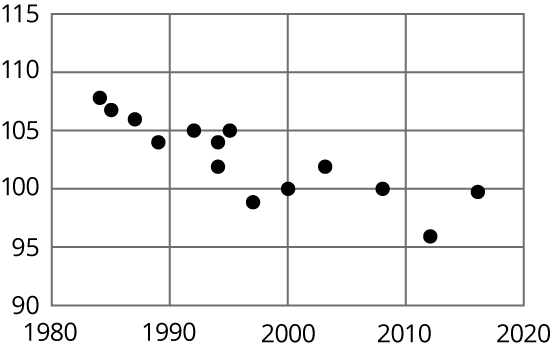
A:
The slope is positive.
B:
The slope is zero.
C:
The slope is negative.
D:
There is no association.
Solution
For access, consult one of our IM Certified Partners.
(From Unit 5, Lesson 21.)